Friday, September 27, 2013

VI. Properties of Cell Membranes
    E) Other processes that move substances through the cell membrane.
            1. Facilitated diffusion- Carrier protein will bond to a molecule that would normally not be able to pass through the membrane. The act of bonding facilitates its transport across the membrane. Goes with the force of diffusion, because of this, it is passive.

 
         2. Coupled Transport- One molecule moves with its concentration gradient through a protein called a transport channel and this "force" will move another molecule into the cell against its concentration gradient.
Example: Insulin and Glucose.


        3. Endocytosis- When the cell engulfs materials and moves them into a cell in a vacuole or vesicle.
               a) Phagocytosis- Surrounding and engulfing particulate material and digesting it.
               b) Pinocytosis- Same as Phagocytosis but the material is a liquid.
               c) Receptor Mediated Endocytosis- Particles bond to specific receptor sites in a pit on the cells surface and this initiates the formation if a vesicle that moves into the cell.
     
         4. Exocytosis- Materials moving out of the cell enclosed in a vacuole or vesicle.


Tuesday, September 24, 2013

Diffusion, Osmosis & Cell Membrane

V. Diffusion & Osmosis
Example 2
-Solution 0.4 M sugar
-Cell 1.0 M sugar
Water goes into the cell by osmosis

When will water movement stop (net) ?
1. when concentrations solutes are equal (Isotonic);
2. when cell would bursts;
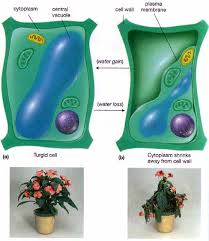
3. when the cell fills enough to create a positive pressure that cancels out the force of Osmosis. (Pressure cancels Osmosis) - This is called Turgor Pressure


VI. The properties of the cell membrane ( The fluid mosaic model ) 

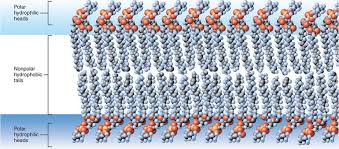
Composed of phospholipids, cholesterol (structural) and proteins (functional)


Functional Proteins:
 A. Channels :
  1. Aquaporins (dedicated of movement of water)
  2. Ion channels (devoted to Na+, Cl-, Ca2+, K+, etc.)

B. Carriers - Could be either active or passive. One molecule could be carried against the force of diffusion (ATP must be burned) or with the force of diffusion

C. Markers - Identify the cell as your own and also identify it as the type of cell

D. Pumps :
  1. Proton Pump - pumps H ions to 1 side of the membrane , creating a proton gradient that is used by ATP (synthase to make ATP)
  2. Sodium-Potassium Pump - uses ATP to pump Na+ out of the cell (neurons) and K+ ions back into the cell. Uses the energy from ATP to cause the protein to change its tertiary structure

Monday, September 23, 2013

11. Central Vacuole: large storage vesicle in a plant cell (lipid storage)
       Note: There are other types of vacuoles, like contactile is some protists
12. Chloroplasts: where photosynthesis happens
       -Double membrane

C. Outside the Cytoplasm
1. Cell Wall: (not in animals) rigid structure made of glucose (cellulose in plants, chitin in fungi)
       -This gives the cell rigidity
2. Cell Membrane: phospholipid bilayer (also some cholesterol and many functional proteins)
       -Fluid Mosaic Model: the ability of the membrane to be selectively permeable
       -Selectively Permeable:
                    a. What can move freely though? = Non-polar, neutrally charged (not an ion), and small
                                  Examples: O2, CO2, NH3
                    b. What can't? = Polar, Ionic, or Big

V.  Diffusion and Osmosis: Passive Processes- No ATP is "burned" here
       A. Diffusion: the passive movement of a substance from a high concentration to a low concentration.
                -Force is determined by the difference between the high and low concentrations
                Example: (find a friend with the picture)
                         #1                                  #2
                     Higher O2                    Lower O2
                       Couch                         Marathon
                             *O2 would have a higher force to #2, O2 would have a lower force to #1
       B. Osmosis:  the passive movement of water (H2O) from a low solute concentration across a 
      membrane to a high solute concentration  
                - Movement stops when the 2 concentrations are equal 
                Example: (find a friend with the picture)
               0.4 M Cell <--------> 0.4 M Sugar
                *"Isotonic": Net movement of a solution is zero
               0.4 M Cell ------>1.0 M Sugar
                *Hypotonic and Hypertonic 
               1.0 M Cell <------0 .4="" m="" nbsp="" span="">
                *Water goes into cell


Friday, September 20, 2013

friday notes

we watched the you tubes video. a tour of the cells bozeman.

B. cytoplasm,
       1.ribosomes, where the proteins are made in a cell. not where the information is found, the RNA that run through it and it make the proteins
       2.vesicle, it is the storage unit in the cell, it can have water,  fat, or other thing in it. also anything needed to be transported out of the cell. 
       3. rough ER. endoplasmic reticulum. it has ribosomes on it, where most ribosomes are found, also where most proteins are made in also make vesicles. make membranes in cells.
       4. Golgi, is an extension of the ER, it is a shipping part of the cell, it tells where to move the thing around the cell or out of the cell.
       5. Cytoskeleton, they are the structure of the cell. three different function, structure, movement, and to provide a rail system inside the cell. it is composed of two different type of structure, micro tuberculin, micro filaments.
       6. smooth ER, make carbohydrates and lipids, it is your detox unit of your cells. if you drink, or a alcoholic you will have more of this.
      7. mitochondria, it generates energy in the form of ATP. it has a double membranes that pumps the protons, and kind of dams it up, and uses the protons to get the power like a hydroelectric plant. they have there own DNA
      8. vacuole, found mostly in plant cells. only in plant cells are they really big, and stores water and help keep shape.
      9. Cytosol, kind of the same thing as cytoplasm. it is the fluid in a cell.
      10. Lysosome, it is a digestion place, it open thing from incoming things, it also breaks down cellular wast. it also destroys the cell.

Wednesday, September 18, 2013

Cells- September 17 & 18, 2013

Cells-Units of organisms
I. The Cell Theory
   A. All organisms are made of cells
   B.Cells are the smallest living unit
   C.Cells only arise from existing cells
II. Why are Cells Small?
    As volume increases in a cell, surface area also increases, but, it does not keep up with volume
     If volume increases 100x, then surface area increases 10x
    Cells need to move outside nutrients in through the cell membrane
    The smaller a cell is, the more efficient it is moving materials into (nutrients) and out (waste) of the cell
III. 2 Basic types of Cells
    A. Prokaryotic- "before the kernal," kernal meaning nucleus. Have no nucleus, nor do they have organelles - internal,   membrane-bond structure. Do have internal membranes. Two kingdoms: Bacteria & Archea. Earliest of these on the planet 3.5 billion years ago.
    B. Eukaryotic- "the nucleus now" Have a nucleus, and organelles. Four kingdoms: Animalia (organ systems are unique to this kingdom, along with the ability to move on your own from place to place, and they are multi-cellular), Plantae, Fungi, Protista.
IV. Structure of a Eukaryotic Cell
    A. Nucleus- "Control Center" Surrounded by a selectively permeable membrane (made of phospholipids, which repel polar substances, and substances with a charge)
  1. Nucleolus- Makes nucleotides (Phosphate-Sugar-Base)
  2. DNA- 46 strands in every human cell, called Chromosomes (when it is condensed, "visible", and wrapped around proteins called histones) or Chromoatin (uncondensed, "invisible")

Friday, September 13, 2013

*test Monday*

Nucleic Acids
    A. DNA
4 Bases:
A-Adenine
T-Thymine
G-Guamine
C-Cytosine

Pairing Rules:
A always pairs with T
G always pairs with C
 

Backbone is made of:
P= Phosphate (PO4)
S=Sugar (Deoxyribose)

Nucleotide= 1 P, 1 S, and 1 Base

Each pair is bonded with a hydrogen bond
( ex. Adenine is bonded to Thymine)

It's a weak bond because when genes are read they need to be "unzipped" or pulled apart


    B. RNA- Ribonucleic Acid-transcribes genes in DNA and then translate them into a protein. 
3 differences from DNA:
1. Single Stranded
2. Ribose Sugar
3. Another base called Uracil (U) replaces Thymine (T)


Uracil has a much shorter life than Thymine
You can make more RNA, but you can't make more DNA

    C. ATP-Adenosine Triphosphate-"Energy Currency."
Really good energy compound

P-P-P
          \
            S-A


ATP--> ADP + P
releases heat

1 Glucose yields 36 ATP on average


Thursday, September 12, 2013

Thursday, September 12 Notes

III. Protein
      A. Stucture
            4 Quaternary-(few)-Multiglobular
                              Hemoglobin-carries Oxygen through our bodies

Denature- breaking the bonds that hold a protein in its 3-D structure. This destroys the proteins function. Heat and pH will do this.

*A protein's function is based completely on its 3-D structure* 
       
       B. Functions
            1. Structure- Hair, Muscle, Bone, Cartilage
            2. Pigment- Melanin
            3. Carriers- Insulin, Hemoglobin
            4. Defense- Antibodies
            5. Contraction- Muscle
      ***6. Enzymes- Catalyze every chemical reaction in an organism. They are exclusive (meaning that every different chemical reaction has a different enzyme).

Catalyze-speeds up chemical reactions by decreasing the level of energy required for the reaction to take place (activation energy)

IV. Nucleic Acids- Made in the Nucleus.
     A. DNA- Deoxyribonucleic Acid- Genetic information.
Gene= Recipe for a protein.